|
  |
|
|
|

La hectárea con mayor biodiversidad del mundo está en la Amazonía ecuatoriana
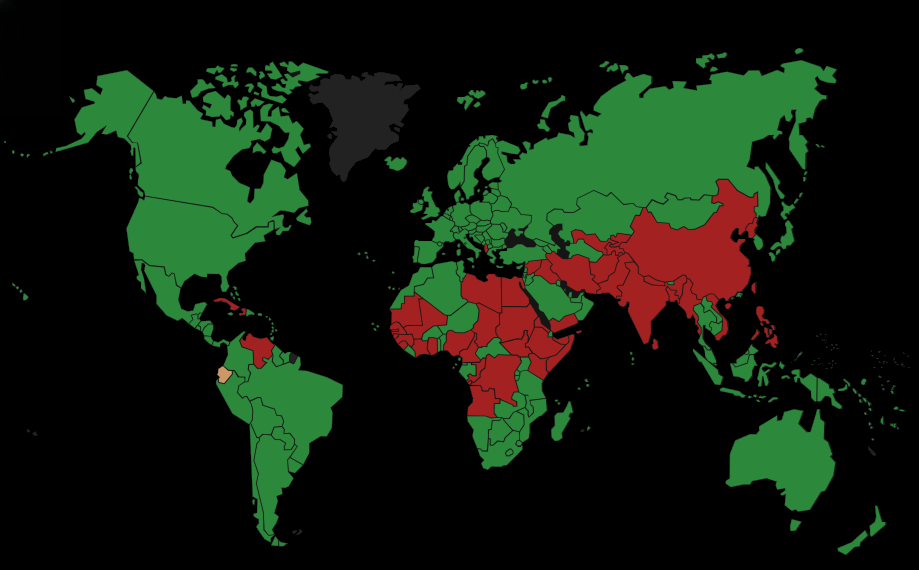
Ecuador es uno de los países más acogedores del mundo. Cualquier persona que ingrese a Ecuador debe tener al menos 6 meses restantes en su pasaporte a la fecha de ingreso. Si bien la mayoría de los pasaportes se aceptan sin visa por 90 días, algunos también la requieren. HAGA CLIC AQUÍ para obtener la información más actualizada. Si su pasaporte es verde, se le otorgarán automáticamente 90 días en su primera entrada a Ecuador, que podrá usar de forma intermitente durante los siguientes 365 días. El conteo comienza al entrar, se detiene al salir, continúa al volver a entrar y se reinicia en el aniversario de la fecha de su primer sello de entrada a Ecuador en su pasaporte actual. Idealmente, es mejor quedarse hasta 85 días al año para evitar problemas; incluso un minuto cuenta como un día completo en días de viaje. También puede solicitar una extensión de visa entre el día 80 y el día 89, pero esta es diferente porque el plazo no se detiene al salir.
Vacuna contra la fiebre amarilla (12 de mayo de 2025): Ecuador actualmente exige a las personas que vienen de Bolivia, Brasil, Colombia y Perú mostrar su tarjeta amarilla de vacunación de la OMS contra la fiebre amarilla. La vacuna debe haber sido administrada al menos 10 días antes del ingreso a Ecuador.
Q. Which airport should I fly to?
A. We are based in Mindo so the best airport to use is Quito Airport (UIO). It has one terminal and is easy to navigate.
Q. Which currency does Ecuador use?
A. United States Dollar (USD) and cash is preferred in $5, $10, and $20 bills. Debit cards can be used at bank machines in medium to large cities for up to $500 per transaction. Credit cards are sometimes accepted in tourist towns and larger cities but with a surcharge.
Q. Does Mindo have a bank machine?
A. There is no international bank machine in Mindo that we recommend, but there are two (Banco Pichincha and JEP) in the nearby town of Los Bancos. Mindo does have a national bank machine (COAC San Miguel de los Bancos).
Q. What type of electrical outlets does Ecuador use?
A. 110 VAC outlets just like in the United States, however, many outlets do not have a ground. A surge protector is a good idea for laptops, but not necessary for battery chargers.
Q. Should I worry about tropical diseases?
A. It depends on where you travel. There is no need to worry about tropical diseases in 4 of the 7 main regions: Galápagos, West Andes, Páramo/Interandes, and East Andes.
Q. Which diseases are in the Chocó Rainforest or the Dry Forest?
A. Dengue is the most common mosquito-borne disease in these regions.
Q. Which diseases are in the Amazon Rainforest?
A. Dengue is the most common mosquito-borne disease, but both Yellow Fever and Malaria are also present. We recommend getting the Yellow Fever vaccine at least two weeks before travelling to the Amazon and it offers protection for at least a decade. The vaccine is not a requirement to visit most of the Amazon. Anti-Malaria tablets are available but since they often come with side-effects, we have decided not to use them on most of our trips.
Q. Which languages are common in Ecuador?
A. Spanish is the official language in Ecuador. Kichwa (ESP: Quechua), Shuar, and other indigenous languages are official regional languages. Although English is the most common foreign language, Ecuador has one of the lowest English proficiency scores in Latin America.
Q. Which timezone is Ecuador in?
A. Ecuador has two timezones: ECT (GMT-5) and GALT (GMT-6). Daylight savings does not exist in Ecuador.
Q. What is the weather like in Ecuador?
A. It depends mostly on elevation. In the lowlands (Galápagos, Chocó Rainforest, Dry Forest, and Amazon Rainforest), it will feel like summer. In the highlands (Western Andes, Páramo/Interandes, and Eastern Andes), it will feel like spring. Ecuador also has mountains that have permanently snow-covered peaks, and it will feel like winter nearby these glaciers. Precipitation varies between wet and dry season, and this varies by locality. Wet season generally starts in late December or early January. In some regions on the east side of the Andes, dry season starts at this time instead.
Q. Which seasons are better for herping?
A. Dry season is better for photography to protect the camera gear. Wet season is usually better for amphibians, and an umbrella can help protect the camera gear for in-situ photography. Some species are easier to find in the dry season and others are easier to find in the wet season. We plan our public adventures based on when we want to visit each region.
Q. How much should I pack for a herping trip to Ecuador?
A. We recommend that photographers bring one checked bag for clothing, and one carry on for camera gear and all batteries. Non-photographers should be fine with just one bag, or two lightweight bags. Let us know if you have extra space in your checked bag as we do have a wishlist of items that are simply not available in Ecuador such as large sizes of rubber boots and snake hooks.
Q. Which footwear is best for herping?
A. Rubber boots. We can lend you a pair of lightweight rubber boots up to size 44 European. If you need size 45 or larger, we highly recommend bringing them with you because they are not available in Ecuador. We would be happy to buy them from you at the end of your trip to add to our small collection.